How to Draw a Line With Multiple Points in Java

Two rasterized lines. The colored pixels are shown as circles. Above: monochrome screening; below: Gupta-Sproull anti-aliasing; the ideal line is considered here as a surface.
In computer graphics, a line drawing algorithm is an algorithm for approximating a line segment on discrete graphical media, such as pixel-based displays and printers. On such media, line drawing requires an approximation (in nontrivial cases). Basic algorithms rasterize lines in one color. A better representation with multiple color gradations requires an advanced process, spatial anti-aliasing.
On continuous media, by contrast, no algorithm is necessary to draw a line. For example, cathode-ray oscilloscopes use analog phenomena to draw lines and curves.
The Cartesian slope-intercept equation for a straight line is With m representing the slope of the line and b as the y-intercept. Given that the two endpoints of the line segment are specified at positions and , we can determine values for the slope m and y-intercept b with the following calculations: so, .




List of line drawing algorithms [edit]
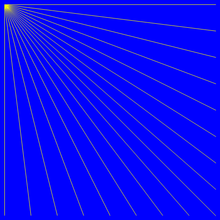
Lines using Xiaolin Wu's algorithm, showing "ropey" appearance.
The following is a partial list of line drawing algorithms:
- naive algorithm
- Digital Differential Analyzer (graphics algorithm) — Similar to the naive line-drawing algorithm, with minor variations.
- Bresenham's line algorithm — optimized to use only additions (i.e. no divisions or multiplications); it also avoids floating-point computations.
- Xiaolin Wu's line algorithm — can perform spatial anti-aliasing, appears "ropey" from brightness varying along the length of the line, though this effect may be greatly reduced by pre-compensating the pixel values for the target display's gamma curve, e.g. out = in ^ (1/2.4).[ original research? ]
- Gupta-Sproull algorithm
A naive line-drawing algorithm [edit]
The simplest method of screening is the direct drawing of the equation defining the line.
dx = x2 − x1 dy = y2 − y1 for x from x1 to x2 do y = y1 + dy × (x − x1) / dx plot(x, y)
It is here that the points have already been ordered so that . This algorithm works just fine when (i.e., slope is less than or equal to 1), but if (i.e., slope greater than 1), the line becomes quite sparse with many gaps, and in the limiting case of , a division by zero exception will occur.


The naïve line drawing algorithm is inefficient and thus, slow on a digital computer. Its inefficiency stems from the number of operations and the use of floating-point calculations. Line drawing algorithms such as Bresenham's or Wu's are preferred instead.
References [edit]
Fundamentals of Computer Graphics, 2nd Edition, A.K. Peters by Peter Shirley
How to Draw a Line With Multiple Points in Java
Source: https://en.wikipedia.org/wiki/Line_drawing_algorithm
0 Response to "How to Draw a Line With Multiple Points in Java"
Enregistrer un commentaire